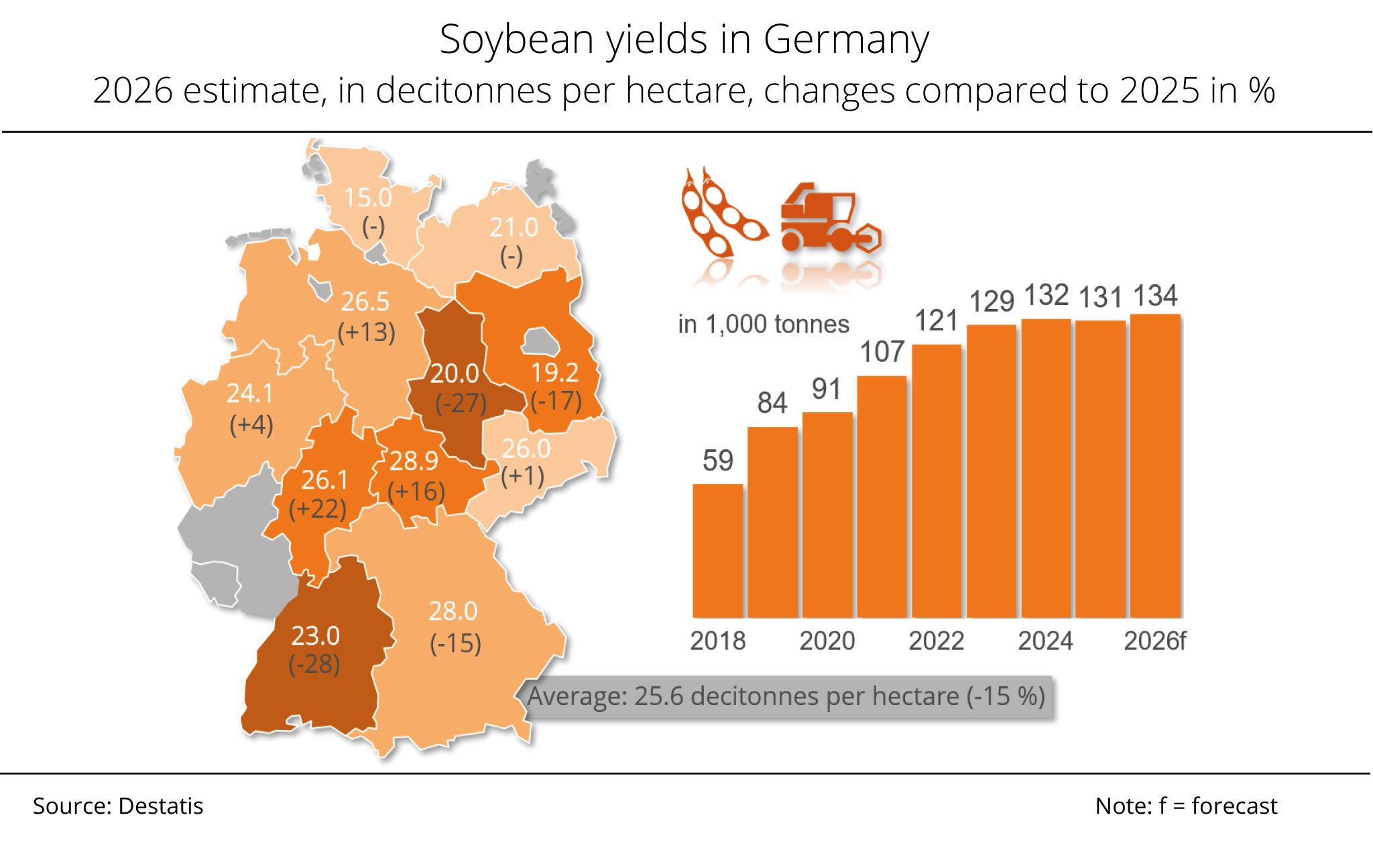




According to data from the German Federal Statistical Office, the 2026 German soybean harvest is expected to exceed the previous year's output, reaching a new record high despite significantly lower yields per hectare. The increase in production is due to an expansion of the crop area.
According to Agrarmarkt Informations-Gesellschaft, soybean farming did not play a major role in Germany until 2015 but has since steadily gained importance.
In 2026, the soybean area increased significantly compared with the previous year, rising nearly 21 per cent to 52,300 hectares.
Preliminary data from the German Federal Statistical Office show a soybean harvest of 133,800 tonnes, an increase of just over 3,000 tonnes on 2025. The rise in production is based on an expansion of the crop area.
At a projected 25.6 decitonnes per hectare, average yields are significantly below the previous year's level of 30.2 decitonnes per hectare. Like other crops, soybeans suffered from this summer's dry spells.
Bavaria and Baden-Wuerttemberg continue to be Germany's leading production regions. Whereas output in Bavaria increased 2 per cent to 76,400 tonnes, the harvest in Baden-Wuerttemberg is expected to remain approximately 23 per cent below the previous year's level, reaching 18,000 tonnes.
In both German states, the soybean area increased compared with the previous year, meaning that the declines are exclusively due to the expected significantly lower yields. Signs of considerable drops in yields are also seen in Saxony-Anhalt and Brandenburg. In contrast, North Rhine-Westphalia, Hesse, Thuringia and Lower Saxony reported increases in harvest volumes.
The Union zur Förderung von Oel- und Proteinpflanzen (UFOP) views the expansion in soybean area as an encouraging development and as a sign of growing interest among farmers in integrating soybeans and grain legumes in general into their crop rotations, thus contributing to more resilience, biodiversity, climate change mitigation and security of supply for vegetable protein.
Soybean production in Germany: larger area, lower yields