



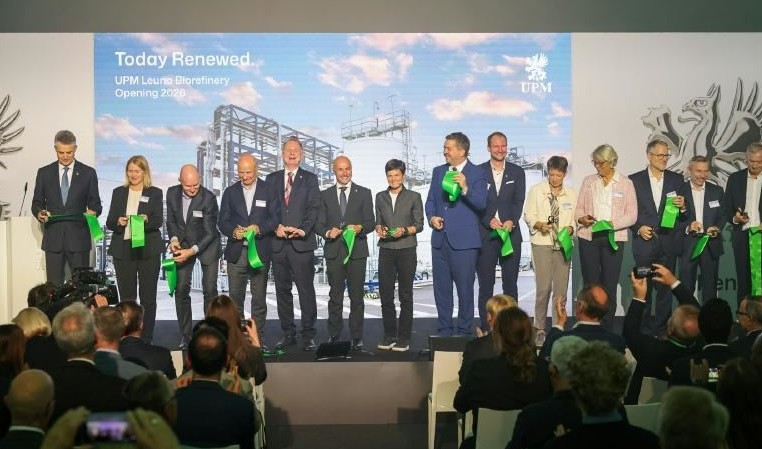
UPM has officially inaugurated its €1.37 billion biorefinery in Leuna, Germany, a landmark investment that strengthens Europe’s renewable fuels and bio-based chemicals sector.
The Finnish giant said the facility is now ramping up production, with enzymatic hydrolysis and lignin-derived speciality chemicals already operating steadily as commercial sales increase.
With an annual production capacity of 220,000 tonnes, UPM describes the Leuna plant as the largest biorefinery of its kind in the world. The facility converts lignocellulosic biomass, primarily sourced from sustainably managed forests and sawmill residues, into renewable chemicals that can replace fossil-derived feedstocks across a wide range of industries.
Although focused on chemicals rather than transport fuels, the project highlights the growing role of advanced biomass conversion technologies in the wider biofuels and bioeconomy sectors.
Using advanced enzymatic hydrolysis, the plant breaks down wood into industrial sugars and lignin, both of which can serve as renewable building blocks for products ranging from packaging and textiles to cosmetics, tyres and construction materials.
UPM said the investment complements its renewable fuels business and demonstrates the commercial potential of non-food biomass as a sustainable alternative to fossil resources.
Massimo Reynaudo, president and chief executive of UPM, described the project as a transformative milestone for the company.
“The Leuna Biorefinery is a transformative investment for UPM and an important milestone in our growth journey,” he said. “Together with our renewable fuels, the Leuna Biorefinery forms a platform for profitable growth.”
The opening also represents a significant step for Europe’s bioeconomy ambitions.By bringing commercial-scale production of renewable carbon-based products to market, the Leuna facility demonstrates how technologies developed for advanced biofuels and biomass processing can be deployed at industrial scale, helping to accelerate the transition towards a more sustainable and circular economy.