



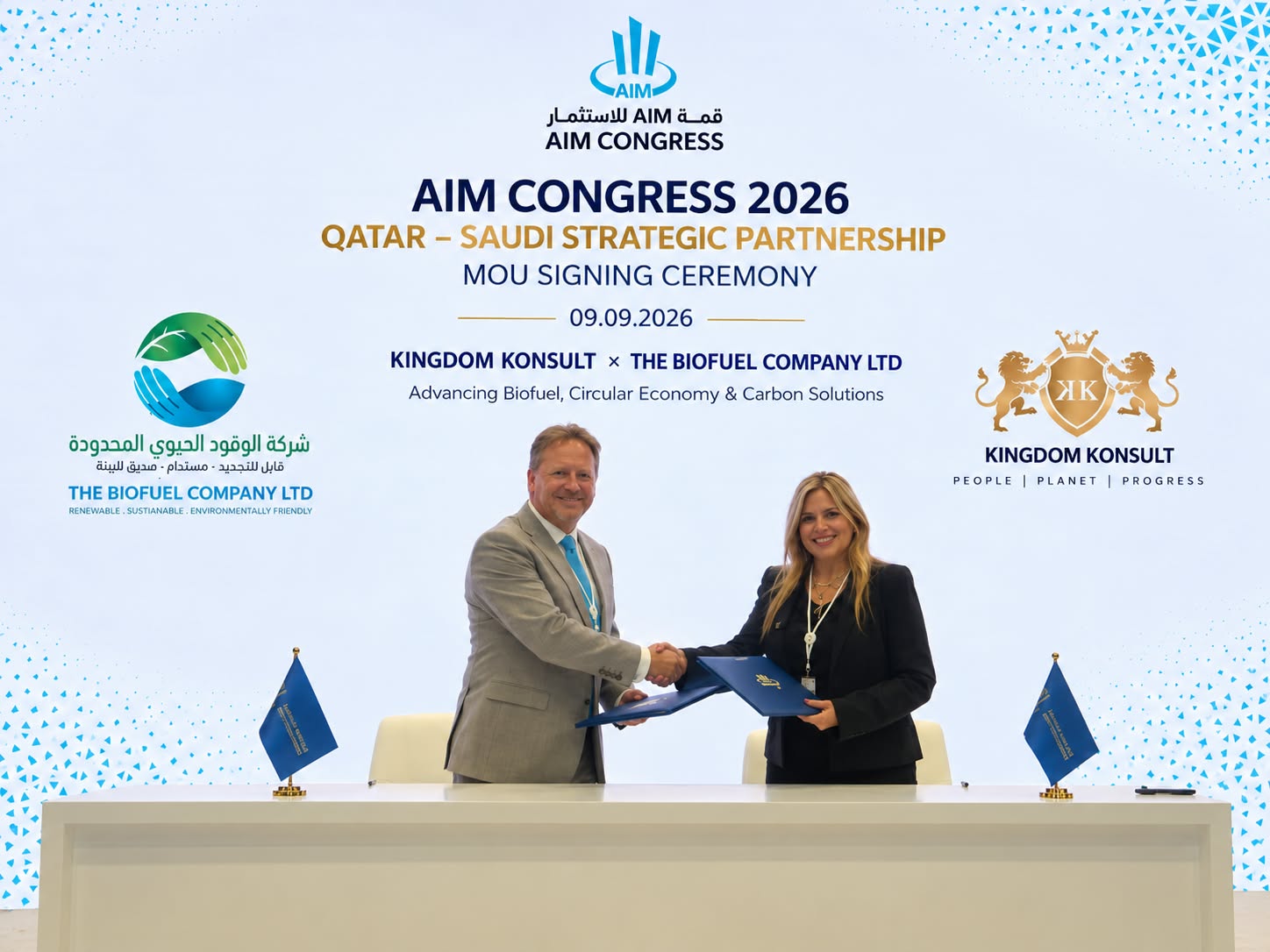
Kingdom Konsult (KK) and the Biofuel Company of Saudi Arabia (TBFCO) have signed an exclusive strategic partnership to introduce B100 biofuel to the State of Qatar, marking a major milestone for sustainable energy deployment in the region.
The agreement was announced during AIM Congress 2026 in Dubai.
Under the collaboration, KK will lead market development, stakeholder engagement and commercial opportunity creation, while TBFCO will supply B100 biofuel alongside technical expertise, certifications and deployment support.
The partnership connects TBFCO’s production and supply capabilities with KK’s sustainability, circular‑economy and energy‑transition expertise in Qatar.
The initiative supports Qatar National Vision 2030 and the Third National Development Strategy 2024–2030, contributing to the nation’s target of reducing greenhouse gas emissions by 25% by 2030.
B100 offers a practical decarbonisation pathway for diesel‑dependent operations, strengthening energy diversification and resilience at a time of shifting global energy dynamics.
Miss Katina Aghayan, chairman and founder of Kingdom Konsult, said: “Biofuel and alternative energy today are not only about sustainability and reducing emissions; they are increasingly connected to energy security, geopolitical resilience and the need for diversified and reliable energy solutions.”
Abdullah Al Otaibi, CEO of TBFCO, added that B100 provides organisations with a practical alternative fuel solution while supporting wider ambitions for decarbonisation and energy resilience. Gary Hubbard FCILT, SVP Commercial & Operations, emphasised the importance of moving from ambition to real‑world application.
The partnership will pursue opportunities across government entities, logistics, industry, construction, education, hospitality, sports facilities and major events, including pilot projects and commercial‑scale deployments.
It also reflects growing GCC‑to‑GCC cooperation in building a diversified, lower‑carbon regional energy ecosystem.