



Germany’s biodiesel foreign trade gathered pace in the first half of 2026, with both exports and imports posting solid year‑on‑year gains, according to new figures from the Federal Statistical Office.
The Netherlands – anchored by the Rotterdam and Amsterdam ports – remains the dominant hub for flows into and out of Germany, underscoring its central role in Europe’s biofuel logistics.
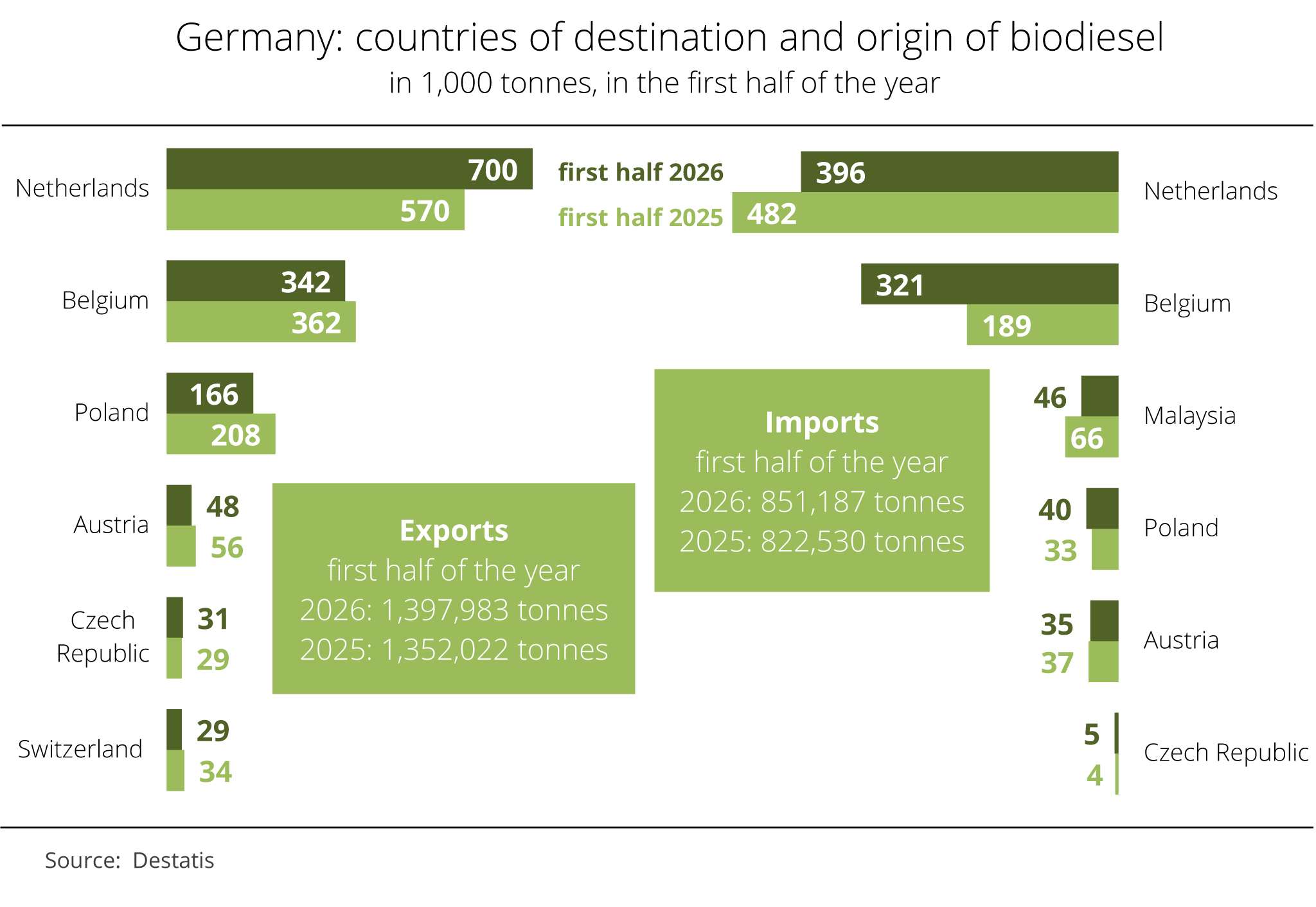
German biodiesel exports rose just over 3.4% compared with the same period in 2025, reaching 1.4 million tonnes between January and June. Imports showed a similar trend, climbing 3.5% to 851,200 tonnes.
Analysts at Agrarmarkt Informations‑Gesellschaft (mbH) report that, alongside the Netherlands, significant volumes originated from Malaysia and Belgium. While Malaysia’s shipments to the EU fell sharply – down 30.2% – Belgium’s deliveries surged by approximately 69.6%, reflecting shifting trade patterns and supply availability.
EU Member States remain the primary destinations for German biodiesel, particularly the Netherlands, Belgium, Poland and Austria. Dutch demand strengthened markedly, rising 22.8% year‑on‑year, whereas Polish imports contracted by around 20.3%.
UFOP highlights that biodiesel exports to neighbouring EU markets continue to support rapeseed oil prices and, in turn, producer returns for rapeseed growers. This price stability has helped offset regionally disappointing harvest results.
The association expects firm pricing into the 2026/27 season as Member States implement the revised Renewable Energy Directive (RED III), which mandates higher biofuel quotas. UFOP also notes that rising HVO imports – estimated at 325,000 tonnes in the first half of 2026 and not included in Destatis data – further demonstrate strong demand for rapeseed‑based fuels.
The association points out that major agricultural economies such as the US, Canada and Brazil use national biofuel policies as active instruments to support farm incomes, a strategy UFOP believes will continue to influence global market dynamics.
Germany’s biodiesel trade accelerates as EU demand strengthens