




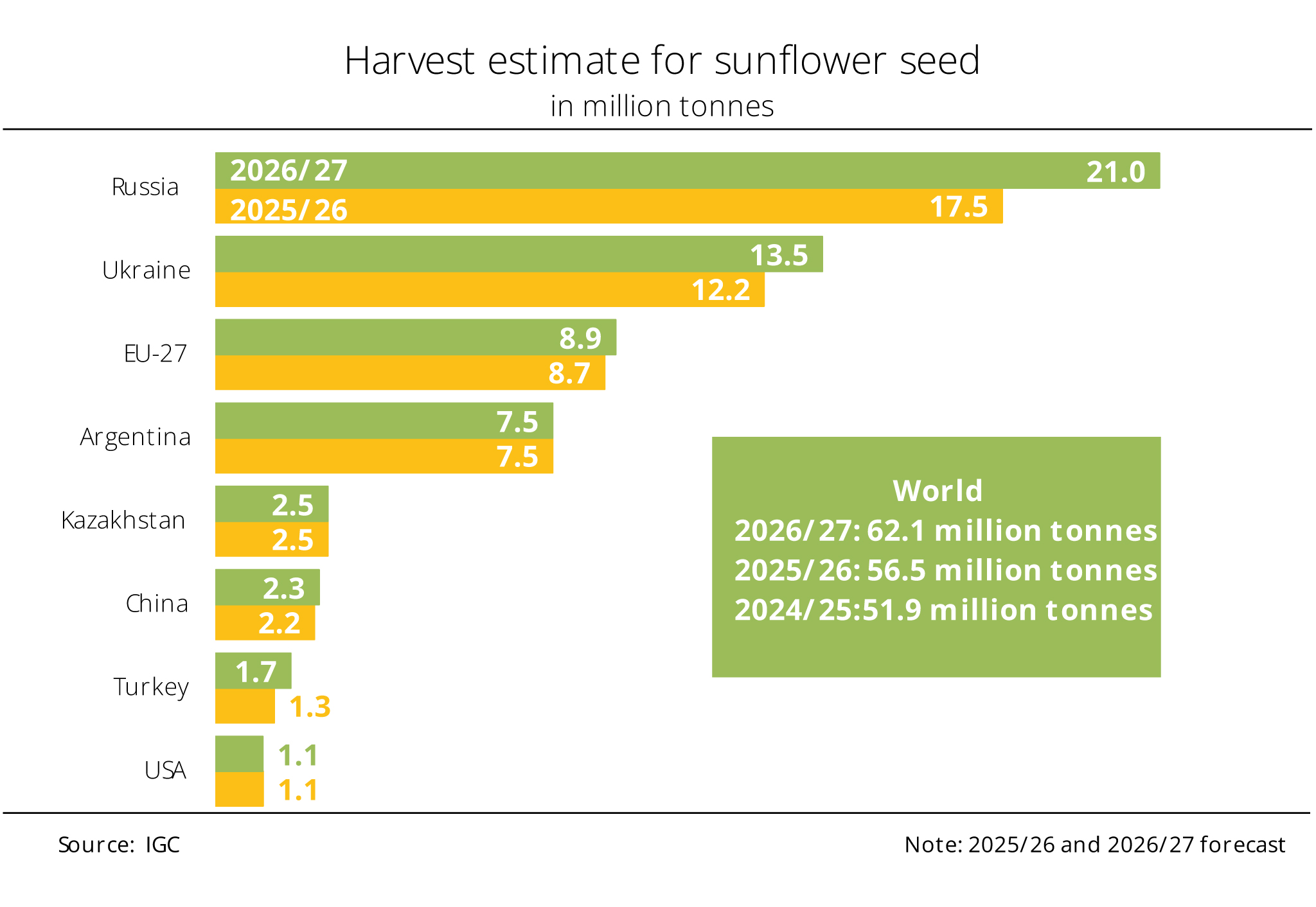
According to information published by the International Grains Council (IGC), global production of sunflower seed could increase to 62.1 million tonnes in the 2026/27 season, representing a rise of approximately 10 per cent on the previous season.
The main reason for this growth is higher production in the Black Sea region.
Russia is expected to reach a new record high, with a projected harvested area of 12 million hectares and an 8 per cent increase in output.
Continued ample demand for sunflower products both in Russia and abroad has led to a 70 per cent expansion in sunflower seed area within 10 years.
The IGC puts Russian production at a record 21.0 million tonnes, up from 17.5 million tonnes the previous year, due to mostly favourable growing conditions. Production in Ukraine, the world's second-largest sunflower seed-producing country, is expected to increase around 11 per cent to 13.5 million tonnes.
In Argentina, sowings have started. According to research by Agrarmarkt Informations-Gesellschaft mbH, with the harvested area remaining unchanged and yields in line with the trend, production is expected to reach the previous year's 7.5 million tonnes.
In light of the need to adapt to climate change, the Union zur Förderung von Oel- und Proteinpflanzen (UFOP) regards sunflower production in Germany as an increasingly attractive alternative for diversifying crop rotations.
Sunflowers require less nitrogen than winter crops while tolerating dry spells. UFOP expects to see further progress in breeding for this trait, which would enhance the crop's competitive position in crop rotation systems.