



A newly identified marine microalga called Sphaerica is set to bolster sustainable aviation fuel (SAF) feedstock supply, offering refiners worldwide a scalable, and independent oil stream for HEFA, SAF and renewable diesel.
The growing SAF feedstock challenge
For much of the past decade, the challenge facing SAF was how to produce it. Today, that challenge is changing.
As HEFA refining capacity expands across major fuel markets, attention is turning to a more fundamental constraint: the availability of sustainable oils required to supply those assets at scale.
With waste oils finite and agricultural feedstocks under increasing land-use pressure, interest is growing in non-arable biological oil sources capable of supplying hydroprocessing infrastructure without competing with food production.
Microalgae were once expected to fill this role. Yet repeated attempts to cultivate laboratory-selected strains at industrial scale ended in widely publicised programme failures.
The concept worked in controlled environments, but large-scale outdoor systems struggled with poor yields and culture crashes caused by fluctuating sunlight, temperature swings, salinity changes and biological contamination.
Rethinking algal biofuels
By the mid-2010s, most programmes had concluded that algal systems lacked the biological resilience required for sustained commercial-scale cultivation.
In practice, these failures reflected poor biological selection more than inherent platform limitations.
Strains were chosen for convenience from established culture libraries, rather than for durability under environmental stress.
Put simply, the organisms had not evolved for the job that was being asked of them.
Rather than engineering robustness into fragile laboratory strains, researchers at the University of Cambridge took a different approach.
If an organism suitable for industrial cultivation existed, evolution would likely have already done much of the work. The challenge was to find it.
Following a move to King Abdullah University of Science and Technology (KAUST) in Malaysia, a rare opportunity unfolded.
Sustained funding and access to coastal biodiversity enabled a decade-long bioprospecting programme focused on the discovery of naturally stress-adapted marine microalgae shaped by extreme environmental conditions.
It was from this effort that Sphaerica emerged - a new-to-science genus of marine microalga.
Searching for industrial resilience
The premise guiding the search was straightforward. Candidate species were stress-tested under prolonged exposure regimes mimicking operational conditions. Only those capable of stable, sustained growth advanced.
Within this framework, Sphaerica distinguished itself. Genomic and physiological studies revealed traits rarely combined in previously studied strains.
The organism divides by multiple fission, producing four daughter cells per cycle and supporting rapid population turnover.
A thick outer capsule provides protection against predation and ultraviolet stress, while tolerance to elevated salinity allows stable growth in seawater environments unsuitable for conventional laboratory algae.
Under nutrient limitation, the standard mechanism used to trigger lipid production, Sphaerica shifts metabolism toward the accumulation of energy-rich triacylglycerides (TAGs).
For industrial cultivation, these traits significantly improve culture stability and support repeatable lipid productivity under fluctuating environmental conditions.
From marine discovery to refinery feedstock
The oils produced by Sphaerica are predominantly C16-C18 TAGs, forming a marine algae oil stream structurally analogous to the vegetable oils, animal fats, and used cooking oils already processed via HEFA-SAF and renewable diesel technologies.
Following extraction, oil streams undergo clarification prior to refinery transfer. Degumming, moisture reduction and trace metal removals produce a conditioned TAG intermediate ready for integration into conventional HEFA pre-treatment and hydrodeoxygenation units.
This allows the oil to be handled commercially as a refinery-ready renewable feedstock rather than untreated algal extract. A sustainable feedstock that can be used to produce:
- SAF;
- Renewable diesel for heavy-duty transport;
- Distillate fractions suited for marine fuel pools.
Because the upgrading infrastructure is already in place, Sphaerica’s value lies in feedstock supply rather than downstream technology.
Cultivation, cost curves and conversion pathways
Unlike cellulosic or carbohydrate-based biofuel routes that require multiple biochemical conversion stages, an oil-based platform offers a far more direct pathway - cultivation to extraction to hydrotreating.
Fewer processing steps reduce operational complexity, capital intensity and cumulative energy demand across the value chain.
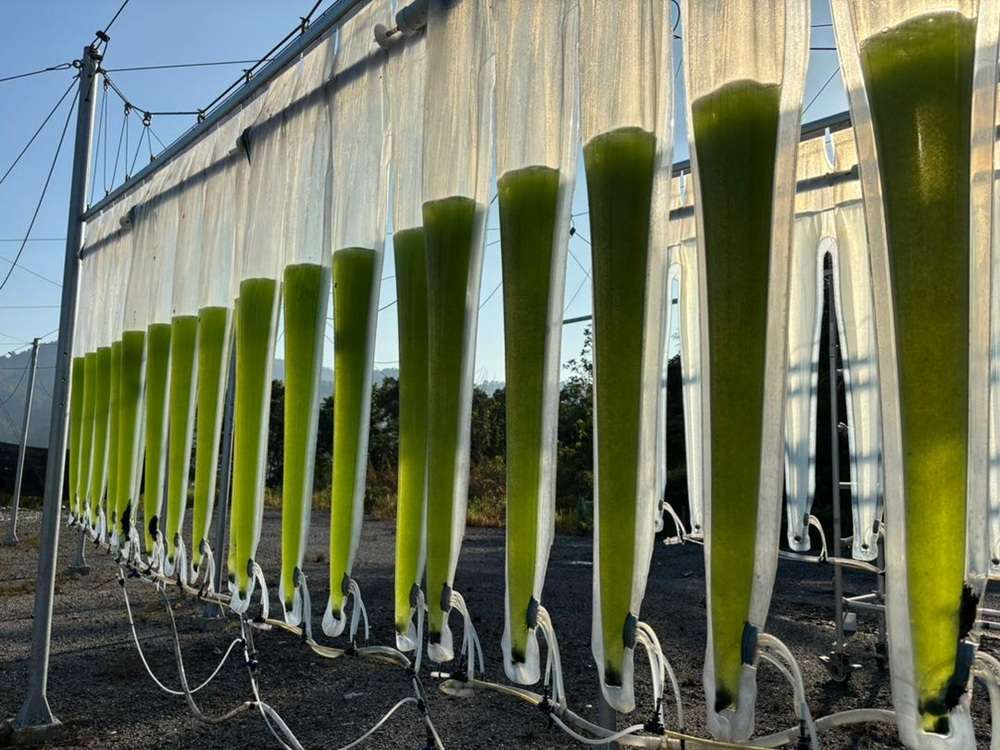
Sphaerica is cultivated in automated, remotely monitored, vertically enclosed photobioreactor (PBR) systems.
These are designed to optimise light penetration and nutrient uptake, maintain stable growth and support high oil yields.
The PBR platform has been cost-engineered for structural efficiency and modular deployment, reducing construction costs and embodied carbon while enabling phased scale-up.
The combination of inherent biological resilience and clever engineering is central to achieving competitive cost curves.
Robust cultures improve continuity and reduce the risk of culture crashes, while modular systems allow disciplined capital expenditure and flexible scaling.
Together, these factors create a production platform capable of very large-scale deployment - potentially covering up to 500 km² - with cost structures approaching fossil fuel parity over time.
For SAF to scale in line with tightening mandates, feedstock volumes must grow in parallel with refining capacity.
That growth will only materialise if renewable oils can be supplied at prices that progressively approach cost parity. Refining infrastructure alone cannot compensate for an uncompetitive upstream feedstock base.
Bridging Regions: Production and Deployment
Although discovered in tropical waters, Sphaerica’s potential extends globally. The Middle East, with its intense sunlight, extensive coastlines, and abundant seawater, stands out as a natural starting point for deployment. Similar conditions exist across parts of North Africa, Western Australia and parts of the Americas, where non-arable land and saline resources align with industrial-scale deployment.
From these coastal cultivation hubs, clarified oil intermediates can be transported efficiently to nearby HEFA refineries or exported to Europe, Asia and North America - markets where SAF mandates are tightening and hydroprocessing capacity continues to expand.
Signalling a quiet but important shift. Moving biofuel production to non-arable coastal systems to supply a distributed network of renewable refineries and in doing so, unlocking new geographies and reshaping the biofuel map.
Securing the Next Phase of SAF Feedstock Supply
As Sustainable Aviation Fuel mandates tighten across Europe and other major aviation markets, the urgency to secure scalable, sustainable feedstock will only intensify. Refining capacity is expanding rapidly, yet the constraint is increasingly upstream.
The history of algal biofuel has been marked by ambition ultimately outweighing execution, but the fundamentals remain compelling: a non-arable oil source that is decoupled from food production, independent of freshwater demands, and fully aligned with existing HEFA infrastructure. If resilient platforms such as Sphaerica can consistently deliver refinery-ready oils at competitive cost, they may not merely complement existing feedstocks; they could materially expand global supply.
For an industry seeking credible pathways to scale, that shift would be strategically significant.