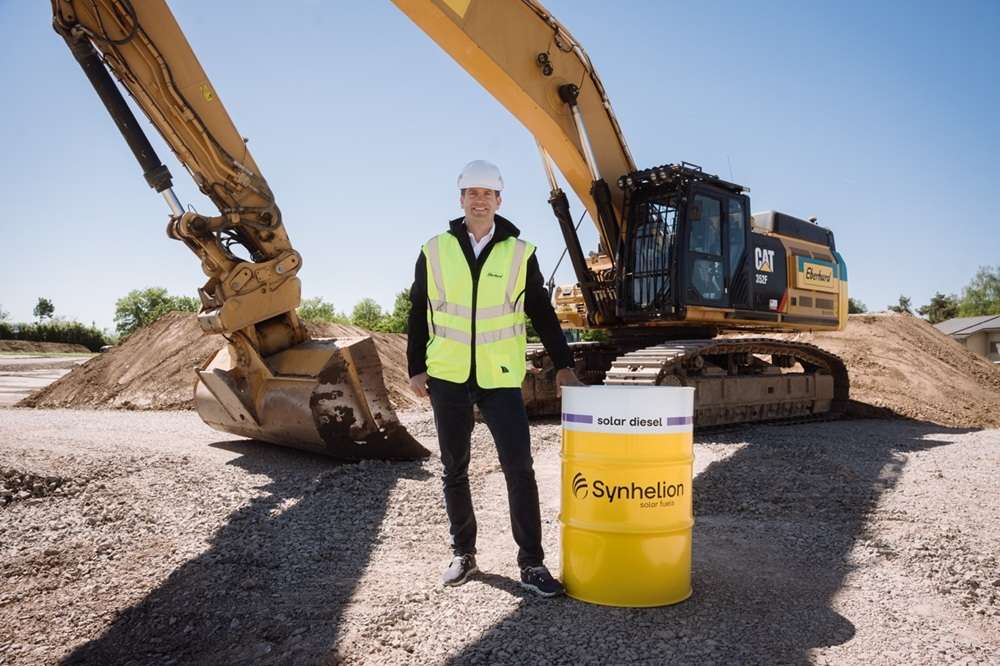




Cleantech company Synhelion has fuelled an excavator operated by Swiss construction company Eberhard Bau AG with renewable diesel for the first time.
The deployment at the Brüttener Tunnel construction site near Bassersdorf (Zurich) demonstrates that synthetic fuels perform reliably even under demanding conditions.
The renewable synthetic diesel comes from Synhelion’s DAWN plant in Jülich, Germany, which has been producing fuels at industrial scale since 2024. With this first delivery, the two Swiss companies send an important signal for the sustainable transformation of the construction industry.
Heavy construction machines are difficult to electrify due to their high energy demands. On construction sites, with rough terrain and typically limited infrastructure, liquid fuels therefore remain the most practical solution.
Synhelion’s renewable diesel delivers the same performance as conventional diesel while reducing net CO₂ emissions by up to 100%.
As a drop-in fuel, it can be used in existing engines without any technical modifications, as demonstrated by its application in Eberhard Bau AG’s excavator. Starting in 2027, the leading Swiss construction company will source larger volumes of Synhelion’s diesel.
“Our employees operate heavy construction machinery under demanding conditions. What matters most is performance and reliability. This first deployment of Synhelion’s diesel shows that renewable fuels work seamlessly in day-to-day construction operations,” said Silvan Eberhard, head of logistics at Eberhard Unternehmungen.
“Machines in the construction and infrastructure sectors will continue to rely on liquid fuels for a long time to come,” added Philipp Furler, Co-CEO and Co-Founder of Synhelion. “Renewable fuels offer a realistic and immediately deployable solution to reduce emissions in this sector. To make a real contribution to net-zero emissions, it is now crucial to scale up our technology in order to bring down production costs.”
Synhelion fuels excavator with renewable diesel