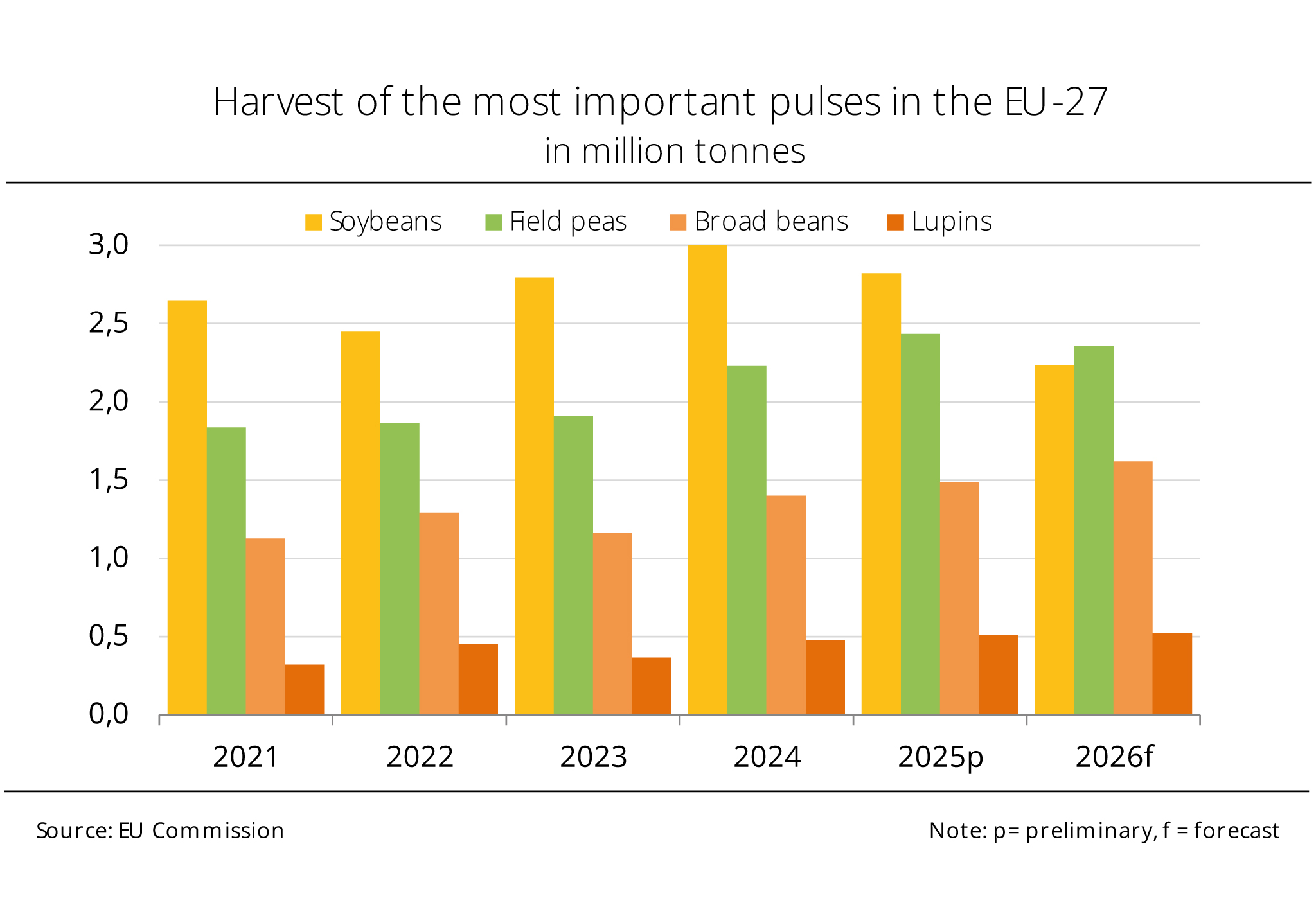




According to estimates by the European Commission, EU legume production for the 2026 harvest will fall 7 per cent below the previous year's level.
The mean of the past five years is nevertheless expected to be exceeded.
According to figures published by the European Commission, the legume harvest throughout the EU will likely reach just over 6.7 million tonnes in 2026, representing a 7 per cent decrease from the previous year.
Soybeans are likely to record the sharpest decline, with production expected to fall 21 per cent compared with the previous year, reaching 2.2 million tonnes.
According to Agrarmarkt Informations-Gesellschaft (mbH), the losses are due to both the reduction in the area under cultivation and expected lower yields. Soybeans in particular had suffered from the intense heat wave that swept across Europe in June.
Accounting for 35 per cent of total pulse output, dry pea is the most important pulse crop in the European Union, even though its harvest is 3 per cent below the previous year's output, reaching 2.4 million tonnes.
This is mainly due to lower yields, as the dry pea area increased just over 1 per cent. The hectarage of field beans was also expanded.
The EU Commission estimates output at 1.6 million tonnes, representing around a 9 per cent rise compared with the previous year. Sweet lupins are also expected to yield a larger harvest, reaching 524,000 tonnes, an increase of 3 per cent from the previous year.
The Union zur Förderung von Oel- und Proteinpflanzen e.V. (UFOP) has noted that the development of legume production confirms farmers' fundamental interest in maintaining or even expanding the cultivation of legumes.
However, the association has criticised the fact that the benefits these crops have for biodiversity and climate change mitigation are not adequately priced in.
The production of grain legumes must pay off in crop rotations in the long term to prevent the repeatedly expressed political call for more resilience in arable farming from coming to nothing.
Smaller soybean harvest reduces EU legume output