





Advances have been realised by steering feedstock away from edible oils toward second and third-generation lipid sources, including waste oils, animal fats, non-edible oil crops, and emerging fourth-generation microbial pathways, thereby lessening competition with food systems while lowering water use and lifecycle greenhouse gas emissions.
Concurrently, innovations in catalyst design and process integration have enhanced deoxygenation efficiency, selectivity toward diesel-range hydrocarbons and byproduct utilisation, while facilitating reductions in hydrogen consumption and improved compatibility with low-carbon hydrogen sources.
Lifecycle carbon intensity reductions have been further strengthened through energy-efficiency improvements, refinery co-processing strategies, and the combination of carbon capture and storage technologies, in some cases enabling the production of ultra-low- or net-negative-carbon-intensity fuels under established regulatory systems. These technological advances have been reinforced by the development of blending mandates and low-carbon fuel policies across major global markets, including North America, Europe, and the marine and heavy-duty transport sectors.
Collectively, these converging factors explain the recent expansion of renewable diesel capacity and investment worldwide and indicate a transition of biodiesel and renewable diesel from compliance-driven fuels toward strategically optimised, scalable low-carbon energy carriers.
Apprehending these developments is essential for steering future research, industrial deployment, and policy formulation in advanced biofuel systems.
Introduction
The last three years have been essential for the biodiesel sector, which has rapidly evolved from niche alternatives to mainstream energy carriers within the global transportation sector.
This transformation has been driven by the convergence of technological advancements, policy initiatives to decarbonise, and growing concerns about the environmental and economic impacts of conventional fossil fuels.
Recent years have witnessed accelerated progress due to innovations in feedstock diversification, catalyst development, and refinery integration, as well as the implementation of stringent lifecycle carbon intensity standards.
These advances have enabled the industry to shift toward non-food, low-carbon feedstocks and adopt process technologies that significantly reduce greenhouse gas emissions, water use, and land competition relative to traditional petroleum-derived fuels.
Simultaneously, regulatory frameworks such as low-carbon fuel standards and blending mandates have fostered market expansion and incentivised investment in advanced production and carbon management technologies.
The integration of carbon capture and storage (CCS), improvements in hydrogen sourcing, and the adoption of lifecycle assessment methodologies further reinforce the sector’s capacity to deliver ultra-low- or even net-negative-carbon-intensity fuels.
As a result, biodiesel and renewable diesel are increasingly positioned as strategic solutions for decarbonising hard-to-abate sectors, including heavy-duty transport and shipping, while supporting energy security and rural economic development.
This paper examines the latest technological, regulatory, and market-based developments in biodiesel and renewable diesel, with a particular emphasis on the period from 2023 to 2025 and discusses their implications for the future trajectory of advanced biofuel systems.
- Feedstock diversification and impurity tolerance
The renewable diesel industry is shifting from reliance on waste oils to non-food, low-carbon feedstocks such as cover crops, algae, forestry residues, and mixed lipid streams.
There have been advances in the production of these materials, most point to one benefactor: the diversification now in place. For example, soybeans are the primary food utilised in countries such as the U.S and Brazil. Rapeseed and palm oil are the primary sources in Europe.
This means that about 95% of the world’s ethanol production comes from edible oils [1]. The feedstocks are shifting away from these oils toward second- and third-generation sources, including cooking oil, animal fats, and non-edible oils such as jatropha and camelina [2].
The good news about these sources is that they are near-carbon-neutral. They are classified this way because cooking oil is a byproduct that is reused rather than wasted. Animal fats are produced as by-products of meat production, so they are not purpose-grown.
Redirecting these fats into feedstock means they are diverted from rendering or disposal paths that emit CO2 and methane.
Oils such as Camelina and Jatropha absorb atmospheric CO₂ during growth, offsetting combustion emissions.
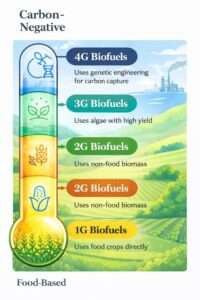
These crops do not compete directly with food production for space or water. They are estimated to reduce water consumption by up to half for the growth of a single field. Fourth-generation research is also underway, leveraging genetically engineered microorganisms to reduce CO2.
This is still research, but it provides a realistic roadmap, as shown in Figure 1, for advancing the raw materials used for ethanol in biodiesel [3].
Catalyst innovation
The good news about these sources is that they are near-carbon-neutral.
They are classified this way because cooking oil is a byproduct that is reused rather than wasted.
Animal fats are produced as by-products of meat production, so they are not purpose-grown.
Diverting these fats into feedstock means they are diverted from rendering or disposal paths that emit CO2 and methane.
A key factor in catalyst innovation in renewable diesel production is system-level optimisation, which involves improving process integration alongside catalyst-chemistry enhancements.
As facilities scale up, optimizing reactor configurations, temperature profiles, and hydrogen management becomes critical to maximising conversion efficiency and catalyst lifespan.
Recent studies indicate that system-level modifications, such as two-stage hydrotreating and advanced reactor designs, can improve selectivity and extend catalyst life, reducing operating costs [4].
In addition to traditional catalysts like NiMo/γ-Al₂O₃ and Pd/γ-Al₂O₃, which are known for their high activity and selectivity toward C15–C17 alkanes, research has expanded to include bimetallic and non-noble metal catalysts.
For example, CoMo-based catalysts and Ni–W supported on novel carriers are becoming influential due to their improved resistance to sulfur and nitrogen poisoning, as well as enhanced performance with high-impurity feedstocks [5].
Recent data show that catalyst formulations with customized pore structures and promoter elements can achieve triglyceride conversion rates exceeding 98% while limiting byproduct formation [6].
These advances are also enabling the effective processing of mixed lipid streams, additionally improving feedstock flexibility and process sustainability.
Overall, the convergence of advanced catalyst design and system-level process improvements is delivering significant gains in both product yield and process efficiency.
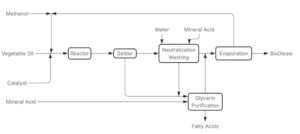
In figure 2, you can see how the process works, ensuring that renewable diesel production remains economically viable and environmentally sustainable at commercial scales.
Lifecycle carbon intensity reduction and carbon capture integration
Carbon Intensity (CI) reductions in renewable diesel production are achieved through increased energy efficiency, strategic feedstock optimization, and carbon capture and storage (CCS) technologies.
Recent studies in existing CCS projects show that combining CCS with biogenic CO₂ streams can enable the production of ultra-low or even net-negative CI fuels, substantially advancing decarbonisation goals.
The studies focus on the 77 existing plants and include 47 additional plants under construction [8], [9], [10].
These systems have grown at a compound rate of 30% since 2017, with gains across all stages of development, from early capture through commercial operation, including electricity generation [10].
Advanced lifecycle methodologies, such as those standardized and employed by regulatory systems like California’s Low Carbon Fuel Standard, are critical tools for precisely quantifying and verifying these emissions reductions [11], [12].
Moreover, retrofitting existing petroleum refineries for co-processing with renewable feedstocks provides considerable opportunities to scale up renewable diesel production while reducing capital expenditure compared to greenfield projects [13]. However, increasing the renewable share in co-processing does have technical constraints, including catalyst deactivation and process co-integration issues, but ongoing innovative efforts continue to expand these limits [14].
Lessons learned from the recent rapid scale-up of mega-scale renewable diesel facilities, such as those in the United States and Europe, reveal best practices in feedstock flexibility, supply chain management, and integration with CCS, while additionally highlighting lasting challenges in regulatory compliance, technology adaptation, and market unpredictability [15], [16].
Convergence with sustainable ship fuel pathways
Biodiesel is demonstrating very positive results for the planet's health.
New Danish data collected showcases that this kind of fuel may reduce emissions by up to 81% [17].
It is important to note that this was the estimate, according to researchers, of how much it could reduce, but now, finally, after testing at sea, it has been proven through the CLEANSHIP Project.
This research showcases the efficiency and capability of biodiesel, with ships and trucks (already the majority utilise a low percentage blend of biodiesel).
It was an expected result, a B100 (100% biodiesel), but it was more than expected, just how big the number was.
There already exist programs mandating that companies begin utilising biodiesel blends in the next few years [18], [19].
Results like these help lawmakers incentivise the use of this blend, as it has happened in the past, such as in RenovaBio in Brazil [20], Germany passed drafts before the EU even mandated the use of biofuels [21], exemplifying its strength and benefits in the environment.
This also boosts sales of Biodiesel, incentivising companies to invest more in research and production, to achieve more results like this and spark a new fever in the biofuel sector.
Road transport adaptation
Heavy-duty trucks and buses consume approximately 40% to 50% of the global diesel production yearly [22].
It would be no surprise that they would be the primary focus of research and the target of carbon reduction efforts.
It is estimated that a high concentration blend of B100 may lower CO2 emissions between 30% and 70% [23].
Tests run by Mercedes-Benz in Brazil show that even a B100 blend from a B15 blend results in a significant difference, with CO2 emissions 65%[24] lower than the B15 base case. But it is far from achieving a number like that.
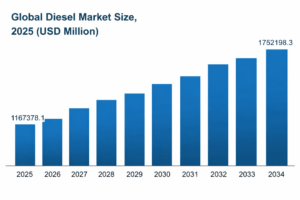
Biodiesel is still used as a drop-in fuel at blend levels of 5% to 20% in 2025. Diesel consumption is on the rise, as always, but so is the biodiesel market; in 2023, about 76 billion liters of biodiesel were utilised, estimated of being 3.5% of the global diesel pool [25]. Figure 3 shows global investment in diesel.
It is speculated that it has not grown further due to rising feedstock prices.
Conclusion
Overall, the biodiesel and renewable diesel sectors have undergone a notable transformation in recent years, driven by technological innovation, supportive policy frameworks, and expanding feedstock diversity.
The shift toward second- and third-generation feedstocks, advances in catalyst design, and the integration of carbon capture and storage technologies have enabled the production of fuels with lower lifecycle carbon intensities and smaller environmental footprints.
These achievements have been additionally strengthened by regulatory mandates and incentives that foster persistent investment and market growth across global regions and transport sectors.
Despite ongoing technical and economic obstacles, including feedstock supply, process integration, and market unpredictability, the sector's competence to adapt and innovate signals an encouraging trajectory for the continued scale-up and planned deployment of biodiesel and renewable diesel.
As countries and industries accelerate efforts to decarbonise transportation and achieve climate targets, these fuels are ready to play a central role in enabling a sustainable, resilient, and low-carbon energy future.
Current research, industry collaboration, and policy evolution will be essential to realizing the entire potential of advanced biodiesels as both compliance-driven and strategically optimized energy options.
Biographies
Dr Raj Shah is a Director at Koehler Instrument Company in New York, where he has worked for over 25 years. He is an elected Fellow of ASTM, IChemE, AOCS, CMI, STLE, AIC, NLGI, INSTMC, the Institute of Physics, the Energy Institute, and the Royal Society of Chemistry. An ASTM Eagle Award recipient, Dr Shah recently co-edited the bestseller Fuels and Lubricants Handbook.
Mr Diogo Moscato is a junior studying Computer Science at Arizona State University. He is a professional motorsports driver, competing in Brazil’s Copa Truck and previously in NASCAR. He also serves as a Petroleum Research Intern at Koehler Instrument Company.
References
[1] “Sustainable biodiesel production: importance of feedstock resources and production methods.” [Online]. Available: https://pubs.rsc.org/en/content/articlehtml/2025/ra/d5ra03084f
[2] “Biodiesel sustainability: The global impact of potential biodiesel production on the energy–water–food (EWF) nexus.” [Online]. Available: https://www.sciencedirect.com/science/article/abs/pii/S2352186421000560
[3] “Transesterification-derived biodiesel: a comprehensive assessment of feedstock diversity, engine performance, and pathways to sustainable transportation.” [Online]. Available: https://link.springer.com/article/10.1007/s43621-025-02449-2
[4] S. Bezergianni, A. Dimitriadis, and A. Kalogianni, Hydrocracking of waste cooking oil for biofuels production—System optimization and catalyst deactivation, vol. 258. Fuel, 2019.
[5] H. Li and J. Wang, Hydrodeoxygenation of triglycerides to green diesel over NiMo, CoMo, and NiW catalysts supported on modified alumina, vol. 146. Renewable Energy, 2020.
[6] R. Cjaidjaro, S. Bej, and A. K, Recent advances in hydrotreating catalysts for renewable diesel production: Pore structure and promoter effects, vol. 343. Catalysis Today, 2020.
[7] “Biodiesel production process using a homogeneous catalyst system.” [Online]. Available: https://www.researchgate.net/figure/Biodiesel-production-process-using-a-homogeneous-catalyst-system-Bournay-L-et-al_fig1_257948900
[8] “International Energy Agency, ‘Bioenergy for Transport: Technology Roadmap,’ IEA, 2020.”
[9] “J. S. Holland et al., ‘Negative carbon intensity from carbon capture and storage in biofuel production,’ Nature Energy, vol. 6, pp. 388–397, 2021.”
[10] “Global Status Of CCS 2025: Industry Stays The Course Toward Gigaton Scale.” [Online]. Available: https://carbonherald.com/global-status-of-ccs-2025-industry-stays-the-course-toward-gigaton-scale/
[11] “ISO, ‘Environmental management — Life cycle assessment — Principles and framework (ISO 14040:2006),’ International Organization for Standardization, Geneva, Switzerland, 2006.”
[12] “California Air Resources Board, ‘Low Carbon Fuel Standard (LCFS) Life Cycle Analysis,’ 2023.” [Online]. Available: https://ww2.arb.ca.gov/our-work/programs/low-carbon-fuel-standard
[13] “U.S. Department of Energy, ‘Co-Processing of Bio-Oil in Petroleum Refineries,’ 2021.”
[14] “R. L. McCormick et al., ‘Technical Barriers to the Integration of Biomass into Existing Petroleum Refineries,’ Energy & Fuels, vol. 34, no. 2, pp. 1172–1180, 2020.”
[15] “Renewable Energy Group, ‘Annual Report 2022: Expanding Renewable Diesel Production,’ 2022.”
[16] “European Commission, ‘Renewable Energy Progress Report,’ 2022.”
[17] “Biodiesel reduces ship’s black carbon emissions by up to 81%.” [Online]. Available: https://biodieselmagazine.com/articles/biodiesel-reduces-ships-black-carbon-emissions-by-up-to-81
[18] “Brazil’s National Biodiesel Program turns 20, boosting energy transition with Fuel of the Future Law.” [Online]. Available: https://www.gov.br/secom/en/latest-news/2025/01/brazil2019s-national-biodiesel-program-turns-20-boosting-energy-transition-with-fuel-of-the-future-law
[19] “Biodiesel Laws and Incentives.” [Online]. Available: https://afdc.energy.gov/fuels/laws/BIOD
[20] “Brazil raises biofuel levels, sees gasoline self-sufficiency.” [Online]. Available: https://www.reuters.com/business/energy/brazil-raises-biofuel-levels-sees-gasoline-self-sufficiency-2025-06-25/
[21] “German cabinet approves draft biofuels law, food-based ingredient use to continue.” [Online]. Available: https://www.reuters.com/sustainability/climate-energy/german-cabinet-approves-draft-biofuels-law-food-based-ingredient-use-continue-2025-12-10/
[22] “IEA study unveils key role for trucks in global oil-demand growth.” [Online]. Available: https://www.iea.org/news/iea-study-unveils-key-role-for-trucks-in-global-oil-demand-growth
[23] “Volvo Trucks.” [Online]. Available: https://www.volvotrucks.com/en-en/news-stories/press-releases/2024/may/volvo-expands-its-range-of-biodiesel-powered-trucks.html#:~:text=2024-05-16,the%20short%20and%20long%20term”.
[24] “Mercedes-Benz and Be8 prove that vehicles running on 100% biofuel can emit up to 65% less CO2 than those powered by a B15 blend in tests in Brazil.” [Online]. Available: https://en.clickpetroleoegas.com.br/Mercedes-Benz-and-BE8-prove-that-vehicles-running-on-100%25-biofuel-can-emit-up-to-65%25-less-CO2-than-those-powered-by-B15-blends-in-tests-in-Brazil-hl1402/
[25] “Growing Demand for Fats and Oils Due to Global Biodiesel Expansion.” [Online]. Available: https://www.fas.usda.gov/data/growing-demand-fats-and-oils-due-global-biodiesel-expansion#:~:text=The%20production%20of%20biomass-based,the%20global%20availability%20of%20feedstock.
[26] “E-Diesel Market Size.” [Online]. Available: https://www.gminsights.com/industry-analysis/e-diesel-market






 Loading ...