





This review examines recent technological, regulatory, and market-driven developments in corn- and sugarcane-based ethanol production, with emphasis on advances realised between 2023 and 2025.
In corn ethanol systems, enzyme-enabled process enhancements have improved starch and fibre conversion efficiency, increasing ethanol yields without additional land use while simultaneously strengthening coproduct markets such as distillers dried grains with solubles (DDGS) and biochar. Parallel progress in carbon capture and storage has enabled ethanol producers to enter voluntary carbon markets, reducing lifecycle carbon intensity and improving economic resilience.
In sugarcane ethanol, the integration of second-generation (2G) pathways using agricultural residues has expanded operational windows and improved overall resource efficiency, while advances in genetic improvement techniques have accelerated yield gains and climate adaptability.
These technological developments have been reinforced by evolving blending mandates and renewable fuel policies in major markets, including Brazil, the European Union, and emerging aviation and marine fuel sectors.
Collectively, these changes explain the surge in investment and capacity expansion observed globally and signal a transition of ethanol from a compliance fuel towards a strategically optimised, low-carbon energy carrier. Understanding these converging drivers is essential for guiding future research, industrial deployment, and policy design in biofuel systems.
Introduction
The transport industry produces significant greenhouse gas (GHG) emissions, such as CO₂ and methane.
These gases absorb and re-emit infrared radiation, trapping heat in the atmosphere and contributing to global warming and climate change. As a result, renewable and environmentally sustainable fuels are increasingly important.
Ethanol, derived from corn and sugarcane, is already widely used and, in some cases, mandated in the global fuel industry.
Corn and sugarcane are used to produce ethanol because they are rich in fermentable carbohydrates and have well-established production methods.
A factor limiting sugarcane’s global spread is the climate required for cultivation.
Recent advances in biofuel technology include improved enzymes, higher-yield crops and processes that use crop residues to boost yields.
These developments, alongside renewable energy and carbon-reduction efforts, are strengthening collaboration in the sector.
Despite these developments, there remains a need to examine and consolidate the latest progress in biofuel technologies, particularly over the past three years.
Therefore, this review highlights the major technological and sustainability-driven innovations in ethanol during this period. Understanding these advances is essential for future research, global sustainability, and industrial optimisation in the sector.
Advances in corn-based ethanol
2.1. Enzyme and process enhancement
Over the past three years, significant effort has been directed towards developing techniques to improve yield without expanding land use.
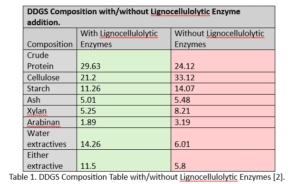
Enzyme technology is a key solution: specific enzymes are now applied directly to the crop or during processing, boosting DDGS (distillers’ dried grains) and ethanol production by facilitating more efficient breakdown of plant material, as shown in Table 1.
This technology is estimated to increase overall ethanol production by 10% [2]. Crucially, these enzymes require only a financial investment, as no additional machinery or space is needed to realise these gains.
2.2. Co-product valorisation
With the rise in biochar production, used in carbon removal technologies, the supply chain was unable to keep pace.
This necessitated expanded intake to support higher production. The expansion focused on residues produced by ethanol plants, which began selling these materials.
Even with ethanol production “waste” being used in biochar production, by 2024 approximately 62% of supply had already been sold, with 28% presold for 2026. This raised prices and generated additional revenue for ethanol producers.
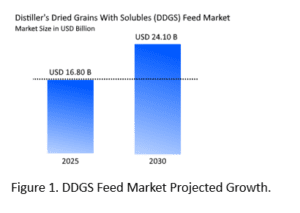
Not only has biochar increased in price, but DDGS has risen as well and is expected to grow by 7.3% from 2025 to 2030, as shown in Figure 1.
This increase in value can be attributed to several factors: governments have begun requiring and encouraging the use of DDGS in livestock nutrition through subsidies and awareness campaigns.
Another factor is price, which is estimated to be 10–15% lower than soybeans, another widely used livestock meal.
To meet this demand, industries have begun investing in machinery upgrades, such as fractionation systems that remove fibre and increase digestibility, now being installed in distilleries [3].
2.3. Carbon intensity reduction
One method for distilleries to offset their environmental footprint is through government carbon credits.
These credits were once considered unattainable due to gas emissions. However, in 2024, the first ethanol plant voluntarily entered carbon markets [4]. Red Trail Energy laid the groundwork for future facilities.
In corn ethanol production, yeast ferments corn starch, producing ethanol, solids, and a high-purity carbon dioxide (CO₂) stream as by-products. The CO₂ that would otherwise be released into the atmosphere is captured.
Exhaust gas from fermentation vessels is directed to a capture facility, where it is purified, compressed into liquid form, and dehydrated to remove impurities.
The liquefied CO₂ is then transported through a flowline to an onsite injection well and injected into the Broom Creek Formation, a secure sandstone layer approximately 6,500 feet below the facility, where it is intended to be permanently stored [5,6].
Advances in sugarcane-based ethanol
3.1. 2G sugarcane
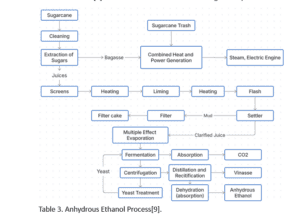
The integration of 2G production facilities with existing 1G mills involves using sugarcane residues, including leaves, bagasse, vinasse, and filter cake [7]. These residues are not fully utilised in 1G processes [8].
Including sugarcane bagasse also reduces the need for additional cultivation areas.
First-generation production occurs for only about nine to ten months per year. Including second-generation residues enables ethanol plants to operate year-round, thereby improving efficiency.
Investments in Brazil are also closely monitoring research into generating electrical energy from bagasse, as shown in Table 3 [9]. This could be essential for reducing future plant costs.
3.2. Genetic improvements
Genetically modified sugarcane traits aim to boost yield, pest resistance, and adaptability to new climates.
Methods such as CRISPR-based breeding and marker-assisted selection help improve traits while minimising unintended outcomes [10]. Classical breeding can take 15 to 17 years [11] and requires large quantities of plant material, much of which is wasted due to genetic or breeding failures.
With modern techniques, researchers can directly modify the genetic code of the plant, reducing the time required to achieve desired sugarcane traits.
Emerging trends and market effects - Laws mandating increased ethanol consumption
More countries, economic groups, and states are opening their energy systems to biofuels. Brazil has approved a law increasing ethanol content in petrol from 27.5% to 35% [12].
Biodiesel is rising from 15% to 25%. The most significant change is in aviation, with a 1% blend starting in 2027, rising to 10% in 2037 and increasing by 1% annually thereafter.
In Europe, the EU is finalising its ethanol blending policies, with a 2030 target of 5.5% renewable fuel [13].
In the US, there is no mandatory ethanol percentage, although financial regulations such as waivers influence consumer behaviour [14]. The transition from E10 to E15, along with expanded availability, further demonstrates growing demand.
Future demand for water and air
Biofuels are commonly used in land transport but less frequently in aviation and maritime sectors. This is beginning to change.
Cargo ships have started blending biodiesel onboard [16], improving fuel properties and usability. Ethanol’s higher solubility in water presents additional handling considerations.
MIT researchers are also developing aviation fuel from biomass [17], creating another pathway for broader biofuel adoption.
Beyond regulatory drivers, expanding use in maritime and aviation introduces challenges related to fuel handling, moisture control, and emissions. Ethanol-based fuels are more hygroscopic than petroleum fuels, requiring improved storage and monitoring systems.
Integrated fuel management strategies, including controlled blending, adaptive combustion tuning, and real-time quality monitoring, will support safe and efficient use. These developments indicate that future biofuel deployment depends not only on chemistry, but also on infrastructure and operational co-evolution.
Market reaction
Biofuel companies are actively positioning themselves for future growth. INPASA, Latin America’s largest biorefinery company, currently produces up to 5.6 billion litres of ethanol annually [19].
It owns the world’s largest biorefinery and plans further expansion, investing nearly one billion dollars into facility upgrades [20].
Their actions demonstrate confidence in the sector’s future. Financial markets increasingly factor carbon intensity and regulatory alignment into investment decisions. ~
Producers demonstrating emissions reductions and coproduct integration are better positioned for favourable financing.
The market is shifting towards scale and integration, with larger facilities benefiting from economies of scale and improved logistics.
As consolidation continues, standardisation and transparency are expected to increase. These trends confirm that biofuels are transitioning from a niche option to a mature component of global energy systems.
Conclusion
Between 2023 and 2025, the corn- and sugarcane-based ethanol sector has made clear progress through increased production, stronger coproduct markets, and supportive policies. Enzyme technologies have boosted ethanol output by approximately 10%.
Biochar accounted for 62% of 2024 supply, with 28% already sold for 2026. DDGS prices remain 10–15% lower than soybean prices and are expected to rise by 7.3% between 2025 and 2030.
For sugarcane ethanol, second-generation processes now enable year-round operation. Policy changes, including Brazil’s ethanol blend increase and the EU’s renewable fuel targets, demonstrate rising adoption.
These developments show that the sector is becoming more efficient, environmentally responsible, and economically competitive. Researchers, policymakers, and industry leaders can use these insights to further accelerate progress towards low-carbon transport. These factors collectively explain the growth in investment observed in the biofuel sector over the past three years.
Biographies
Dr Raj Shah is a Director at Koehler Instrument Company in New York, where he has worked for over 25 years. He is an elected Fellow of ASTM, IChemE, AOCS, CMI, STLE, AIC, NLGI, INSTMC, the Institute of Physics, the Energy Institute, and the Royal Society of Chemistry. An ASTM Eagle Award recipient, Dr. Shah recently co-edited the bestseller Fuels and Lubricants Handbook. He earned his doctorate from The Pennsylvania State University and is a Fellow of the Chartered Management Institute, London. He is also a Chartered Scientist, Chartered Petroleum Engineer, and Chartered Engineer in the UK. He was awarded the honour of “Eminent Engineer” by Tau Beta Pi. He serves on multiple advisory boards and has over 750 publications.
Mr Diogo Moscato is a junior studying Computer Science at Arizona State University. He is a professional motorsports driver, competing in Brazil’s Copa Truck and previously in NASCAR. He also serves as a Petroleum Research Intern at Koehler Instrument Company.
Mr Mathew Stephen Roshan is an undergraduate in Chemical and Molecular Engineering at Stony Brook University. He conducts research in sustainable energy systems and serves as the Fueling and Oiling Lead for Stony Brook’s Formula SAE team.
References
[1] “Pixbay.” [Online]. Available: https://pixabay.com/photos/agriculture-artificial-beaker-bio-4402811/
[2] Distiller’s Dried Grains With Solubles (DDGS) Feed Market Size & Share Analysis - Growth Trends and Forecast (2025 - 2030) Source: https://www.mordorintelligence.com/industry-reports/ddgs-feed-market. [Online]. Available: https://www.mordorintelligence.com/industry-reports/ddgs-feed-market
[3] In Situ Corn Fiber Conversion for Ethanol Improvement by the Addition of a Novel Lignocellulolytic Enzyme Cocktail. [Online]. Available: https://www.mdpi.com/2309-608X/8/3/221
[4] Red Trail Energy Is First Ethanol Plant to Enter Voluntary Carbon Markets. [Online]. Available: https://www.businesswire.com/news/home/20240306717962/en/Red-Trail-Energy-Is-First-Ethanol-Plant-to-Enter-Voluntary-Carbon-Markets
[5] Red Trail Energy is First Ethanol Plant to Enter Voluntary Carbon Markets. [Online]. Available: https://www.ecoengineers.us/insights/red-trail-energy-is-first-ethanol-plant-to-enter-voluntary-carbon-markets
[6] M. Wróbel-Jędrzejewska, Ł. Przybysz, E. Włodarczyk, F. Owczarek, and Ł. Ściubak, Carbon Footprint Analysis of Alcohol Production in a Distillery in Three Greenhouse Gas Emission Scopes. [Online]. Available: https://www.mdpi.com/2071-1050/18/1/57
[7] “Pixbay.” [Online]. Available: https://pixabay.com/photos/cane-sugar-field-2665662/
[8] Optimization of 2G ethanol production from sugarcane bagasse: Upscaling of soda pretreatment with redox mediator followed by fed-batch enzymatic hydrolysis and co-fermentation. [Online]. Available: https://www.sciencedirect.com/science/article/abs/pii/S019689042401166X#:~:text=Enzymatic%20hydrolysis%20of%20the%20pretreated,economic%20viability%2C%20and%20environmental%20sustainability.
[9] Second generation ethanol in Brazil: Can it compete with electricity production? [Online]. Available: https://www.researchgate.net/publication/51526700_Second_generation_ethanol_in_Brazil_Can_it_compete_with_electricity_production
[10] Unlocking the potential of sugarcane: Advances in genomic innovation, biorefinery technologies, and stress resilience, and circular bioeconomy. [Online]. Available: https://www.sciencedirect.com/science/article/pii/S0926669025016267#:~:text=Sugarcane%20genomic%20innovation%20and%20variety%20improvement.%20Sugarcane,primarily%20revolves%20around%20genetic%20transformation%2C%20a%20methodology
[11] Improvement genetic accelerates innovation in the field. [Online]. Available: https://jornal.unicamp.br/en/edicao/723/melhoramento-genetico-acelera-inovacao-no-campo/
[12] “Law No. 14.993, of October 8, 2024.” Brazilian Gov. [Online]. Available: https://www.gov.br/mme/pt-br/assuntos/secretarias/petroleo-gas-natural-e-biocombustiveis/combustivel-do-futuro/law-no-14-993-of-october-8-2024
[13] Biofuels. [Online]. Available: https://energy.ec.europa.eu/topics/renewable-energy/bioenergy/biofuels_en
[14] Ethanol Waivers (E15 and E10). [Online]. Available: https://www.epa.gov/gasoline-standards/ethanol-waivers-e15-and-e10
[15] “Pixbay.” [Online]. Available: https://pixabay.com/photos/skiathos-airport-approach-plane-5003984/
[16] Biofuels for the marine shipping sector. [Online]. Available: https://www.ieabioenergy.com/wp-content/uploads/2018/02/Marine-biofuel-report-final-Oct-2017.pdf
[17] Making aviation fuel from biomass. [Online]. Available: https://news.mit.edu/2023/making-aviation-fuel-biomass-0823
[18] “Pixbay.” [Online]. Available: https://pixabay.com/photos/refinery-oil-industry-gas-3613526/
[19] “The world’s largest biorefinery is in SINOP.” [Online]. Available: https://www.inpasa.com.br/sala-de-imprensa/a-maior-biorrefinaria-de-etanol-de-graos-esta-em-sinop/873440#:~:text=Após%20duas%20ampliações%2C%20em%202024,de%20milho%20de%20segunda%20safra.
[20] “INPASA will make a investment near 3.5 Billion reais in corn ethanol in Mato Grosso (BR).” [Online]. Available: https://www.novacana.com/noticias/inpasa-fara-investimento-r-3-5-bilhoes-em-etanol-de-milho-mato-grosso-181225






 Loading ...