




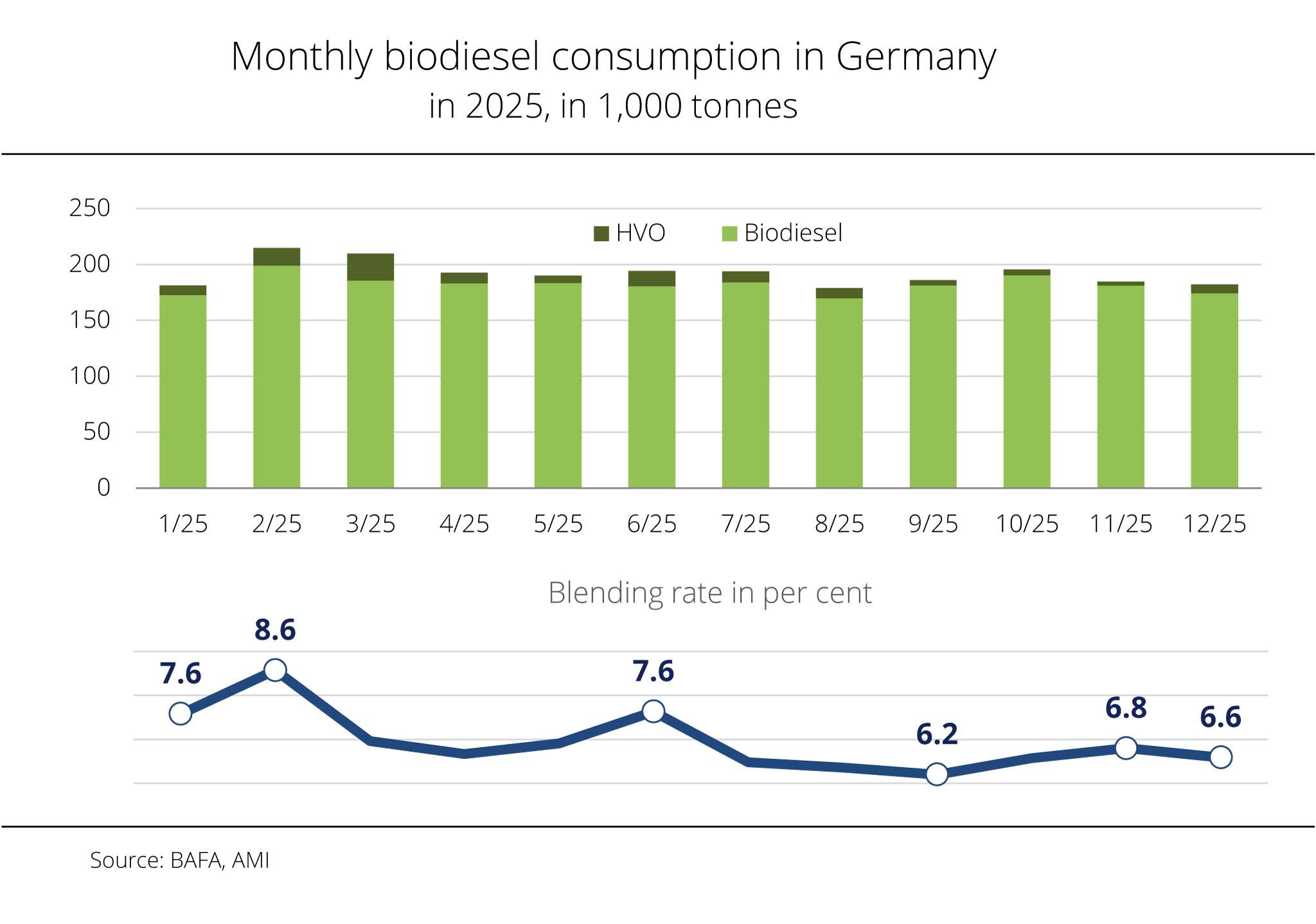
Biodiesel consumption showed a clear upward trend for the 2025 calendar and quota year compared to the historically weak previous 12 months.
HVO volumes fell short of the previous year's level because quota obligations could be met more cost-effectively using biodiesel within the technical cap – the fuel standard for diesel (B7).
It is noticeable that, at the same time, sales of the pure HVO fuel (HVO100) increased.
In 2025, biodiesel incorporation in blends was generally at a stable level with monthly fluctuations. After 181,400 tonnes in January, consumption reached a preliminary record high of 214,868 tonnes in February.
In the months that followed, consumption fluctuated between approximately 180,000 tonnes and 200,000 tonnes and declined slightly towards the end of the year, falling to 182,230 tonnes in December.
The largest volume of HVO was used in March 2025, totalling 24,300 tonnes. Over the remainder of the year, monthly volumes slipped below 10,000 tonnes, with one exception in June. The lowest value, 3,600 tonnes, was recorded in November.
According to information published by Agrarmarkt Informations-Gesellschaft, the use of biodiesel for blending in the 2025 calendar year totalled just under 2.2 million tonnes, which was up around 12 per cent year on year.
The HVO volume amounted to approximately 118,900 tonnes, representing a 17 per cent decline compared with 2024. At 31.2 million tonnes, the use of diesel fuel exceeded the previous year's level by just over 2 per cent.
It should be noted that, according to figures from the Federal Office for Economic Affairs and Export Control (BAFA), the marketing of pure HVO fuel (HVO100) has grown significantly to approximately 132,700 tonnes, whereas biodiesel as a pure fuel (B100) plays a minor role at approximately 6,015 tonnes.