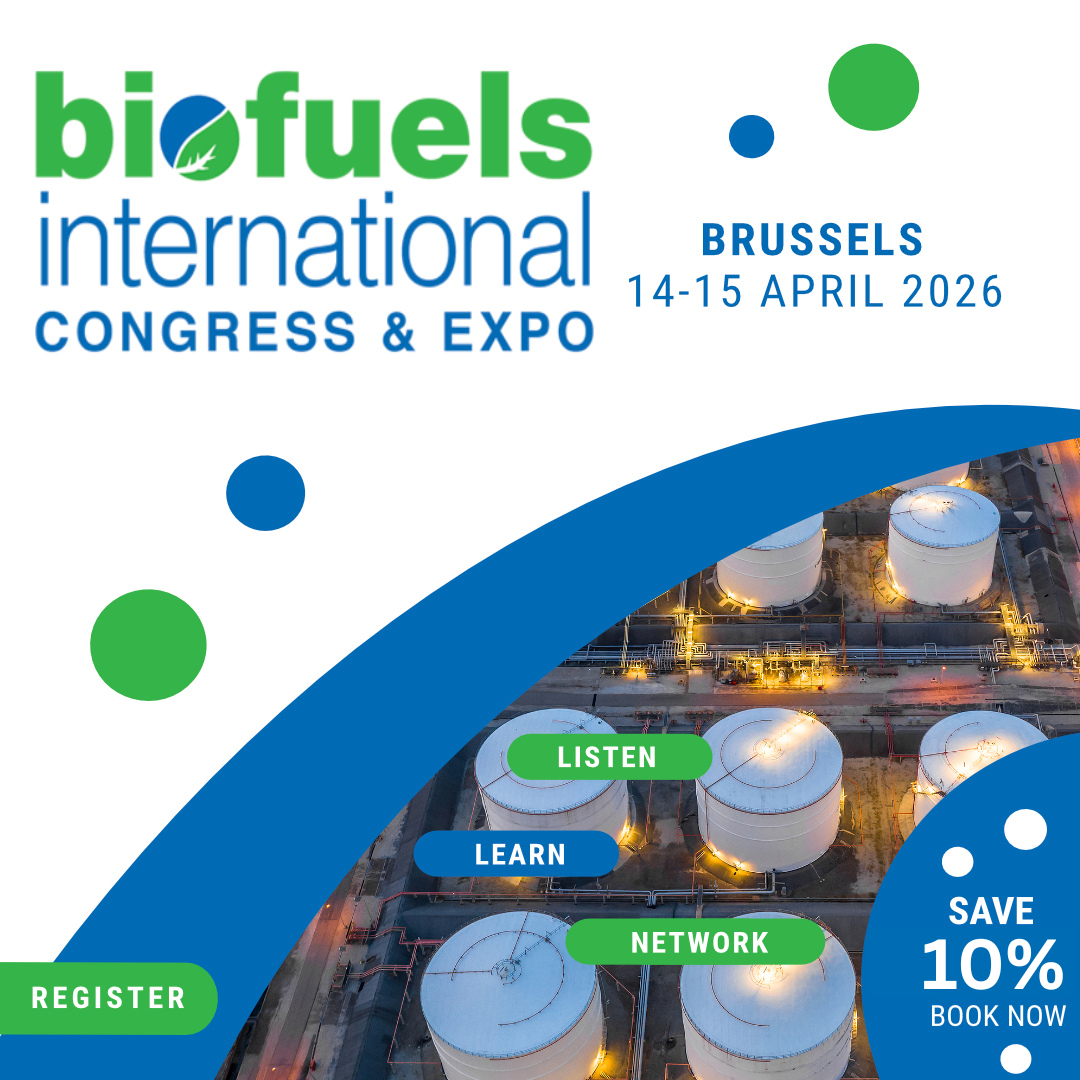






In a month's time, the European biofuels community will once again converge in Brussels for the annual Biofuels Conference and Expo alongside the Sustainable Aviation Fuel (SAF) summit.
Taking place on 14–15 April at the landmark Plaza hotel, the two-day event promises to reflect an industry at a critical point in its evolution.
With governments tightening decarbonisation targets, airlines accelerating SAF commitments and fuel producers investing heavily in new technologies, the Brussels gathering arrives at a moment when renewable fuels are no longer a niche solution, but a central pillar of energy transition strategies.
A strong line-up of speakers from across policy, production, shipping and aviation underlines the breadth of discussion expected over the two days.
Conference shaped by market reality
Among those addressing delegates will be Cornelius Claeys, managing director of CleanMotion advisory who, before that, worked for Neste. He will deliver a wide-ranging market outlook on the state of the biofuels sector.
“My ambition is to provide a broad market outlook for the current state and future expectations of the biofuels industry,” Claeys explained. “To keep it most relevant, the exact topics will depend on the trends and developments at the exact time of the conference.”
He expects his presentation to touch on regulation, supply dynamics and pricing pressures, while also looking beyond traditional road transport.
“It will likely include expectations outside the conventional road segment, as aviation and marine biofuels are growing rapidly, especially in Europe,” he added.
Claeys believes the Brussels event remains one of the most important fixtures in the industry calendar.
“Biofuels International Brussels is one of the most important conferences in the industry,” he said.
“Over the past decade, I have seen the event grow from being a pioneer to remaining a gold standard front-runner, even in a now more crowded space.”
He also highlighted the diversity of voices represented.
“The quality has been consistent, with speakers from production, feedstock, policymaking, associations, technology providers, certifiers and traders.
“My primary goal is always to network with and learn from fellow delegates and speakers, although the beautiful venue and great catering are nice extras.”
On the agenda
Also addressing delegates will be Niels van Velde from the European Biodiesel Board (EBB), who will provide a comprehensive outlook for the European biodiesel market.
“In my presentation, I’ll be giving an outlook for the biodiesel market,” van Velde said. “I’ll cover some statistics to show how the market is evolving, largely drawing from our latest Statistical Report, and I’ll also look at EU regulatory developments that we see affecting producers in Europe.”
He stressed that policy developments remain a decisive factor for the sector’s future direction.
“Regulation continues to shape investment decisions, production capacity and feedstock choices, so it is essential that producers fully understand the implications of upcoming EU measures.”
Van Velde said the Brussels conference remains a key meeting point for the industry.
He added: “The Biofuels International Conference is a great event that brings together stakeholders from across the value chain.
“As an association representing EU producers from all feedstocks and across all transport modes, we meet a lot of relevant people at this conference.”
SAF takes centre stage
For the third year, the event will include the dedicated SAF Summit in an adjoining conference room, reflecting the rapid growth of interest in aviation decarbonisation.
The summit will bring together airlines, fuel producers, airports, fuel service providers, regulators and investors to explore how SAF can scale at the pace required by net-zero commitments.
Cemvita will use the platform to highlight how industrial biotechnology is reshaping SAF feedstock supply.
“At Cemvita, we use industrial biology to turn carbon waste into an ultra-low-carbon-intensity renewable oil called FermOil™, which can be upgraded into SAF using existing HEFA infrastructure,” CEO Moji Karimi said.
“We are engineering our first plant in Brazil, where the conditions are right, and we plan to build from there globally.”
In their presentation, Cemvita will challenge conventional assumptions around SAF feedstocks.
“The core message is that biomanufacturing can now deliver the same oil input required by HEFA, but with a significantly lower carbon intensity and without the supply, traceability and scalability headaches associated with UCO, tallow and other agricultural oils,” he said.
“We are already seeing real signals in Brazil and Europe that this transition is happening now, not in some distant future.”
Cemvita also views the Brussels event as a practical forum rather than a purely promotional one.
“These conferences matter only if they lead to execution,” Karimi added. “We don’t show up for visibility or panel talk, but to pressure-test ideas, build trust and move projects forward.
“ The best conferences create real collisions between operators, capital and technology.”
Beyond decarbonisation
While decarbonisation and net-zero will dominate the agenda, organisers stress that energy security, competitiveness and industrial resilience will also feature strongly.
By hosting both the biofuels conference and the SAF summit under one roof, delegates are encouraged to see renewable fuels not as isolated markets, but as part of a broader transition in liquid energy systems.
For many speakers, the real value of the Brussels event lies in its ability to bring together decision-makers who rarely meet in the same setting.
“As an industry, we need fewer slogans and more honest, technical, commercial conversations,” Claeys concluded. “This conference creates the space for that.”
With some new speakers still to be announced, and with interest in SAF and advanced biofuels continuing to rise, the 2026 edition of the Brussels gathering is shaping up to be one of its most important yet.
For more information about both events, visit biofuels-news.com/conference and biofuels-news.com/conference/sustainableaviationfuels/
Brussels hosts pivotal biofuels and SAF gathering






 Loading ...