




AmafilterR, part of Filtration Group, continues to strengthen its role in delivering dependable filtration technologies to the biofuels sector.
As global efforts to reduce carbon emissions accelerate and sustainability regulations expand, the biofuels industry is undergoing rapid transformation. Producers are increasingly working with diverse and challenging feedstocks, including used cooking oil (UCO), animal fats such as tallow, and emerging sources like algae-based and waste-derived biofuels.
Each of these raw materials introduces its own processing difficulties, particularly in relation to solids removal, fluid viscosity, and fouling potential. To consistently produce high-quality biofuels that meet regulatory and performance standards, filtration systems must combine durability with the ability to adapt to changing process conditions and feedstock variability.
What have been the major developments within Amafilter in the past year?
Algae-derived biofuels are attracting increasing attention as a next-generation renewable fuel source due to the exceptionally high oil yield that certain microalgae species can achieve — often exceeding 60% of their dry biomass. Cultivated in aqueous systems such as high-rate algal ponds or photobioreactors, microalgae can efficiently convert sunlight, CO₂ and nutrients into large quantities of biomass rich in lipids that can subsequently be processed into biodiesel.
However, one of the most challenging steps in the process chain is the dewatering and thickening of the algal slurry.
Microalgae cells are extremely small, remain suspended in water and typically cannot be processed with conventional filter aids or precoat systems without contaminating the biomass or complicating downstream processing. In this context, robust cake filtration technologies such as the Cricketfilter, equipped with reinforced heavy-duty filter elements, provide an effective solution.
These reinforced elements are engineered to withstand demanding operating conditions, handling differential pressures of up to 6 bar for efficient biomass thickening while maintaining mechanical integrity and stable filtration performance.
In addition, the Cricketfilter automated system is now available with enhanced design pressures of up to 10 bar, offering an extra margin of durability and safety.
This higher pressure capability supports more demanding algae processing conditions, improves operational reliability, and contributes to extended equipment service life. By operating at higher pressure differentials, the system can increase throughput and achieve higher biomass concentrations, reducing downstream energy requirements for drying or lipid extraction.
As algae-based biofuels continue to develop toward commercial scale, reliable filtration systems capable of handling challenging, filteraid- free suspensions will play a critical role in enabling efficient and economically viable production.
In your experience, what are the main operational challenges biofuels customers face before exploring new filtration options?
From our experience working closely with biofuel producers, the biggest operational challenges often stem from handling viscous fluids and high solid loads.
Traditional filtration systems can struggle with cake formation, rapid clogging, and inconsistent throughput, which leads to downtime and higher operating costs.
Customers also face challenges in maintaining product quality and meeting strict specifications for fuel purity.
Before exploring new filtration solutions, many producers are looking for systems that can improve efficiency without compromising reliability, while minimising the environmental footprint of the process.
This is where Amafilter’s technologies are designed to step in — offering highcapacity, low-maintenance filtration solutions that handle complex feedstocks effectively.
Safety is also an important operational consideration. Frequent filter blockages or manual cleaning interventions can increase operator exposure to hot fluids and chemicals.
Many producers are therefore looking for filtration solutions that reduce manual handling and provide more stable, predictable operation, improving both plant safety and efficiency.
The Amafilter Cricketfilter automated system is designed with operator protection and process reliability in mind.
Automated cake discharge and enclosed operation minimise the need for manual intervention, reducing operator exposure to hot liquids and process chemicals.
The system incorporates controlled operating parameters, pressure monitoring, and automated shutdown features, helping to ensure stable and predictable operation even when processing challenging feedstocks with high solid content.
What are some of the challenges you think the sector is currently facing?
The biofuel sector is navigating a combination of regulatory, supply chain and technical challenges.
On the operational side, many producers are dealing with feedstock variability, which can dramatically affect the performance of existing filtration systems. Additionally, rising energy costs and tight sustainability requirements are pushing companies to rethink their processing efficiency and emissions management.
From a market perspective, biofuel producers must adapt to volatile raw material prices and evolving government incentives, making it critical to invest in equipment that is flexible, reliable and future-proof.
Our focus at Amafilter is to provide filtration systems that address these technical and operational challenges while helping our customers stay aligned with market and environmental demands.
Safety and regulatory compliance are also becoming increasingly important across the sector.
As plants scale up production and process more challenging feedstocks such as waste oils and residues, there is a greater focus on equipment that can operate safely under higher loads and more demanding conditions.
Filtration systems that offer contained operation and reduced operator intervention are becoming a key part of modern biofuel plant design.
What role did sustainability or environmental goals play in the customer’s decisionmaking process?
Sustainability is increasingly a core driver for decisions in biofuel production. Customers are not only looking to meet regulatory standards but are also seeking measurable reductions in energy consumption, waste generation, and environmental impact.
In filtration, the choices they make directly influence the efficiency of their processes and the quality of by-products, which in turn affects overall sustainability.
Amafilter filtration solutions are designed with this in mind — reducing water usage, minimising chemical additives, and ensuring energy-efficient operation. In many cases, our customers report that environmental performance is as important as throughput and cost efficiency when evaluating new equipment.
What role does safety play in filtration for biofuel production?
Safety is a critical consideration in biofuel production, particularly when handling hot oils, solvents, methanol and other potentially hazardous materials.
Filtration systems must be designed not only for performance but also to protect operators and ensure safe, reliable operation under demanding process conditions.
From our perspective at Amafilter, one of the key safety challenges is managing high solid loads and viscous fluids under pressure. Poorly designed or overloaded filtration systems can lead to blockages, pressure build-up, or unplanned interventions, all of which increase operational risk.
Reliable cake discharge, controlled pressure operation, and robust vessel design are therefore essential to maintaining a safe working environment. Another important aspect of biofuel processing is minimising operator exposure.
Enclosed filtration systems play a critical role in enhancing workplace safety by reducing direct contact with hot liquids, chemical additives and biofuel intermediates, while also limiting vapour emissions.
This is particularly important in facilities processing wastebased feedstocks or chemically treated fuels, where operator safety and environmental control are key considerations.
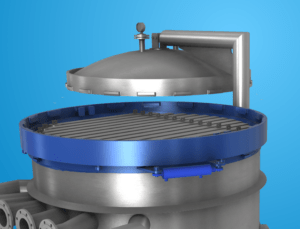
As part of its ongoing commitment to safety and operational excellence, Amafilter has further enhanced the Cricketfilter automated system with the introduction of an advanced hydraulic bayonet opening feature. This design combines robust hydraulic actuation with a secure bayonet locking mechanism, enabling safe, controlled and fully automated opening and closing of the filter. The result is a significant improvement in operator protection, reducing manual intervention while ensuring reliable and secure operation under demanding process conditions.
Ultimately, a well-designed filtration system contributes not only to efficiency and product quality, but also to safer plant operation. Many producers are increasingly prioritising solutions that reduce manual handling, improve containment, and provide consistent, predictable performance as part of their overall safety strategy.
Conclusion
As the biofuel industry continues to evolve, the company remains focused on developing filtration solutions that meet the changing needs of producers and the increasingly complex feedstocks they process. Amafilter is continuously working to refine and expand its technologies to ensure they align with the operational, environmental and safety requirements of modern biofuel production.
Through ongoing innovation and close collaboration with customers, we aim to deliver solutions that are both reliable and adaptable in a rapidly developing market.
For more information: Visit https://www.amafiltration.com/ products/latest-filtration-technology/ renewable-fuel-filtration-cricketfilterpressure- leaf-filter-systems/?utm_ source=Advertisement&utm_ medium=landing+page&utm_ campaign=biofuel_filtration&utm_ id=Biofuel&utm_term=filtration+system s+and+filters+removing+impurities
Boosting renewable fuel production






 Loading ...